Moonlight Cinematography: Colour, Intimacy and Visual Storytelling
Image source: A One-Camera Show: DP James Laxton on Moonlight

Image source: ‘The Underground Railroad’ cinematographer takes …

Image source: “Moonlight” Cinematographer James Laxton on Crafting the Film’s …
The cinematography of Moonlight: colour and intimacy
In Moonlight, colour does not merely make Miami beautiful, and closeness does not simply make Chiron sympathetic. Director Barry Jenkins and cinematographer James Laxton use both to place us inside a life that Chiron often struggles to express aloud. The images can feel lush and dreamlike while remaining attentive to the smallest change in a face or a relationship. 1, 2
Colour as emotion
Miami supplies the film’s vivid starting palette: ocean blues, bright greens, magentas and warm light. Laxton says the locations inspired those colours, which the crew sometimes intensified with coloured lighting in interiors and at night. The effect is expressive rather than strictly naturalistic: the city feels as Chiron experiences it, charged with beauty, fear and possibility. 1
The three chapters also have distinct colour treatments. In post-production, colourist Alex Bickel used film-stock emulations associated with Fuji for childhood, Agfa for adolescence and Kodak for adulthood. These were grades applied to digitally captured images, not different stocks used to shoot the film. The shifts help distinguish Chiron’s ages without breaking the visual continuity of his life. 3
Colour can become sharply specific to a moment. Laxton describes the green of teenage Chiron’s bathroom as an ugliness suited to his distress; a later blue-lit image of the adult Chiron, now called Black, conveys a colder, more guarded state. Neither hue fixes what the character “means.” Each gives an emotional pressure to the scene before he says a word. 3
That strategy also protects the film from looking like a simple coming-of-age chronology. The palette changes with Chiron’s interior state, but the transitions are gentle enough that the film remains legible as one memory rather than three disconnected periods. The result is a visual structure that tracks emotional survival as much as time.
A camera close enough to feel
Laxton says the visual aim was immersion, not observation from a distance. He operated most of the film himself and used diopters—lens attachments that permit closer focus—to bring the camera unusually near the actors. That proximity matters most when Chiron is quiet: a glance, a pause or a refusal to look back can occupy the whole frame. 1, 2
Anamorphic lenses give the film breadth, but Jenkins and Laxton often use that breadth around intimate encounters rather than spectacle. In the adult reunion between Chiron and Kevin, close-ups looking almost directly into the lens make their attention to one another feel immediate. Laxton says the down-the-lens perspective was meant to give viewers a first-person sense of belonging inside the scene. 1, 3
The camera’s nearness also changes how space behaves. Backgrounds do not simply establish geography; they become emotional pressure around the characters. Hallways, doorways, bedroom walls and car interiors feel like places where Chiron is being sized up, held in, or allowed to disappear. In a film about a boy who rarely speaks at length, framing becomes a form of listening.
Light on skin
The film’s intimacy also depends on how it photographs Black skin. Laxton says warm, soft rendering was a priority, while the lighting aimed to feel believable rather than conventionally flattering. Soft sources shape faces without erasing their texture; in the night beach scene, the crew built the light artificially so the actors could remain visible and delicately modelled against the darkness. 1
That beach scene is one of the film’s clearest demonstrations of controlled naturalism. The moonlit look is not a passive record of available light; it is a carefully shaped night image designed to preserve detail in faces, water and sand without flattening the scene into darkness. The blue-black palette gives the moment its quiet, suspended feeling, while the softness of the light keeps it tender rather than stark.
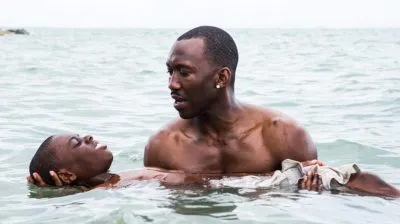
The ocean swimming lesson offers a contrasting kind of closeness. Laxton filmed Juan and young Chiron in the water using the available Miami light, adapting quickly as a storm approached. The moving water and changing sky give the scene a physical immediacy: intimacy comes not from a perfectly controlled image, but from staying near the two people as trust begins to form. 2, 3
That approach is especially effective because it allows the scene to remain simple in composition while rich in feeling. Juan’s body is not isolated from the environment; he is framed as part of the water, the sky and the child’s tentative attention. The lesson works visually because the image is open enough for tenderness to feel earned rather than declared.
Blocking, lens choice and emotional distance
One of Moonlight’s strongest visual ideas is that emotional distance can be shown without literally pulling the camera away. Laxton’s use of diopters and close operating lets faces remain sharp at very short distances, which creates a sense of confrontation even in calm scenes. The viewer often feels placed inside Chiron’s personal radius, where tiny shifts in eye line become dramatic events.
The anamorphic frame is important here because it gives the film room to hold more than one emotional register at once. A scene can feel intimate in the foreground while the wider frame preserves the surrounding world: fluorescent interiors, blue nighttime exteriors, or the flat geometry of a classroom and cafeteria. That contrast keeps the film from becoming visually claustrophobic even when the drama is inward.
This is also why the film’s most restrained scenes can be the most forceful. When Chiron and Kevin sit in the diner as adults, the image does not rely on movement or coverage to create tension. The power comes from proximity, from faces held long enough for hesitation and recognition to register, and from a visual style that gives silence the same weight as dialogue.
Why the look works
Moonlight is often remembered for its beauty, but the deeper achievement is precision. Every major visual decision—colour, lensing, skin tone, night lighting, camera distance—serves the same purpose: to make inner life visible without overexplaining it. The film does not treat colour as decoration or closeness as sentiment; it uses both as tools of dramatic information.
That combination gives the film its particular emotional temperature. Saturated colour keeps the world alive and specific. Soft, near-camera intimacy keeps Chiron from disappearing inside that world. Together, they create a visual language where vulnerability can be seen before it is spoken, and where tenderness feels like a form of light.