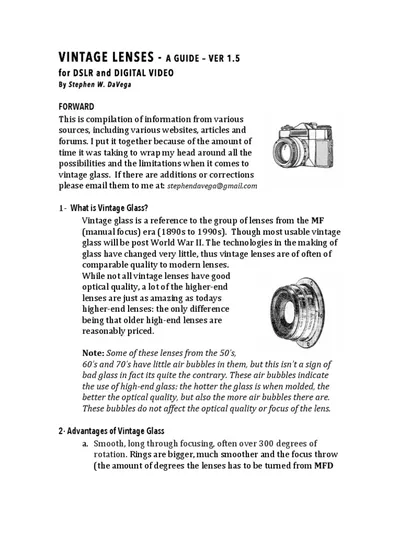
Vintage Lenses on Digital Cinema Cameras: Character, Flaws and How to Use Them Well
Image source: www.scribd.com · document · 517353326Vintage Lenses for Video: A Guide | PDF | Camera Lens | Single…

Image source: Tech-nique / Vintage lenses
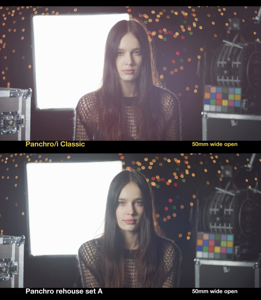
Image source: The Panchro look - Cooke Optics
Vintage lenses on digital cinema cameras: character and flaws
Vintage lenses can give a digital image a distinctive texture: gentler contrast, softer edges, glowing highlights, unusual flare, or out-of-focus backgrounds that feel less uniform than those from modern glass. Those qualities are not a guaranteed “film look.” They depend on the particular lens, its condition, the aperture, the lighting, and how much of its image circle the camera records. Cinematographers value the texture, but also keep modern lenses available when a vintage lens’s flare or softness would compromise a shot. 1, 2
The practical appeal is not nostalgia by itself. Older glass can sit between clinical sharpness and outright diffusion, giving faces a slightly less mechanical rendering and turning strong backlight into part of the image design. On a digital sensor, that can be especially useful when the goal is to soften the precision of modern capture without hiding detail completely.
Where the character comes from
Older optical designs and coatings can leave more aberration and internal reflection visible in the image. With Cooke’s original Speed Panchros, for example, higher-order aberrations reduce contrast most noticeably wide open; their single-layer coatings reflect more light within the lens than modern multilayer coatings. That helps explain the combination of gentle contrast and flare associated with that lens family, though it does not describe every vintage lens. 2
The aperture is a creative control, not just an exposure setting. Opening a lens up can make edge fall-off, softness and highlight glow more pronounced; stopping down can tame some of those effects. On Plastic Surgery, cinematographer Helena Gonzalez began around T4–5.6 and opened to T2.8 as the story became more chaotic, making highlights glow and fluorescent flares less regular. 1
That relationship between aperture and character matters because many vintage lenses are at their most distinctive near wide open. At smaller stops, some of the personality remains, but the image often becomes more even, with less veiling flare and less emphasis on aberration. In practice, many crews treat the aperture as a tone control: open for atmosphere, stop down for discipline.
Color is part of the look as well. Vintage sets rarely match perfectly from focal length to focal length, and that mismatch can be either useful or troublesome. A slight warm bias in one lens and a cooler, lower-contrast response in another may help separate close-ups from wider frames, but the same difference can become a continuity problem if the set is mixed without testing.
Common vintage lens traits and what they mean
| Trait | Possible creative use | Possible cost |
|---|---|---|
| Lower contrast and veiling flare | A softer response to bright light | Backlight can wash out detail or make an image unusable. 1, 3 |
| Softness and edge fall-off | Draws attention toward the centre of the frame | Important features may fall into an unexpectedly soft area. 1, 3 |
| Focus breathing | A visible shift during a focus pull may suit an expressive shot | Framing changes as focus moves, distracting from a precise rack focus. 1, 3 |
| Variation across a set | Each focal length has its own personality | Colour, contrast or exposure may jump between shots. 1, 3 |
| Original mechanics | Preserves an older lens’s optical design | Stiff focus, inconsistent housings or demanding lens changes can slow the crew. 1, 3 |
These traits are not defects in the abstract. They become flaws when they interfere with what the scene needs. A lens that blooms beautifully on a close-up can be the wrong choice for a dialogue scene with precise blocking, a product insert, or any shot that depends on edge-to-edge clarity.
Sensor coverage changes the look
Digital cinema cameras do not all see the same part of the lens. A Super 35 sensor crops away more of the image circle than a full-frame sensor, which can hide weak corners, exaggerate the central “sweet spot,” and make a lens feel cleaner than it would on a larger format. The same lens can therefore seem more forgiving on one camera and more compromised on another.
That is why coverage testing matters as much as focal length selection. A lens that looks attractive on a smaller sensor may show dark corners, smeared edges or field curvature when used on a larger one. It can also reveal the less flattering outer portion of its image circle, where vintage optics often show more astigmatism, color shift or softness.
Cooke distinguishes its Super 35 and full-frame Panchro/i Classic sets partly on this basis. 2 For crews mixing sensors or planning multiple camera bodies, the safest approach is to test the lens on the exact format that will be used in production, not just on a generic camera body.
When flaws become problems
Vintage lenses reward control. The more the scene depends on consistency, the more important it is to identify the point where character becomes distraction. A set that flares in a pleasing way at one angle can turn to veiling glare when a practical lamp sits just outside frame. A gentle softening at the edges can make a portrait feel flattering, but it can also soften hairlines, eyes or text in a way the scene cannot afford.
Focus breathing deserves special attention because it can be hidden in still frames and become obvious only during movement. On a dramatic rack focus, a small change in angle of view may look expressive; on a composed shot with strict geometry, the same shift may feel like the lens is moving when it should not.
Mechanical condition is equally important. Old focus helicoids can be smooth but imprecise, or accurate but stiff. Aperture rings may click unevenly, and some rehoused lenses still retain the optical signature of the original glass while improving handling. That is one reason rehousing exists: to preserve the character while making the lens safer and more usable on set.
Test the shot, not the reputation
Before committing to a set, shoot tests on the intended camera and sensor mode. Lock exposure and white balance, then compare skin, neutral colours, fine detail, frame edges and a light source moved into and around the frame. Repeat at the apertures you expect to use; record a focus pull to check breathing, and verify close focus, focus marks, transmission and the mechanics of each lens. Keep labelled clips so the cinematographer, assistant and colourist can distinguish a useful quirk from a surprise on set. 3
A useful test also includes real scene conditions, not just a chart. Faces reveal color bias and halation differently from static objects, while practical lamps, windows and chrome surfaces reveal flare behavior that a neutral test chart cannot. A lens may look acceptable in a clean studio setup and fail the moment a bare bulb enters the frame.
It also helps to test the whole lens package, not only the optics. Matte boxes, front diameter, filter use, weight balance and focus gear placement affect whether an old lens is practical during a long day. The cleanest image is not necessarily the best choice if the camera team cannot work efficiently with it.
Also check whether each focal length covers the chosen sensor area. A lens that looks appealing on a smaller recording area may reveal less attractive outer portions of its image—or fail to illuminate the larger frame adequately. Cooke distinguishes its Super 35 and full-frame Panchro/i Classic sets partly on this basis. 2
For matching purposes, the key question is not whether a set is “vintage” but whether the lenses behave coherently enough for the project. Some productions want consistent softness and flare across the range; others want one hero focal length with more personality and the rest kept neutral. Matching is less about perfection than about controlled variation.
The best choice is the lens whose specific imperfections serve the scene while remaining manageable for the crew. As cinematographer Jake Polonsky put it, vintage glass cannot make lighting or composition better; it can contribute texture alongside those other decisions. 1